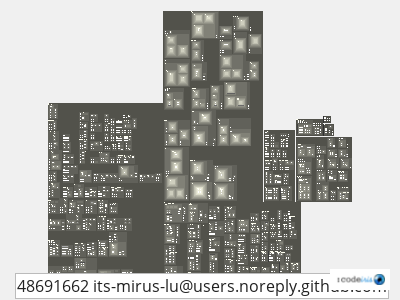
Changes by author
What it measures
How many commits touched each file and who made them.
How to read it
Each building is a file. Its height is the number of changes, split into stacked segments, one color per author.
Why it matters
Shows at a glance where the work happens and which people carry which parts of the code.
open interactive view more about this metric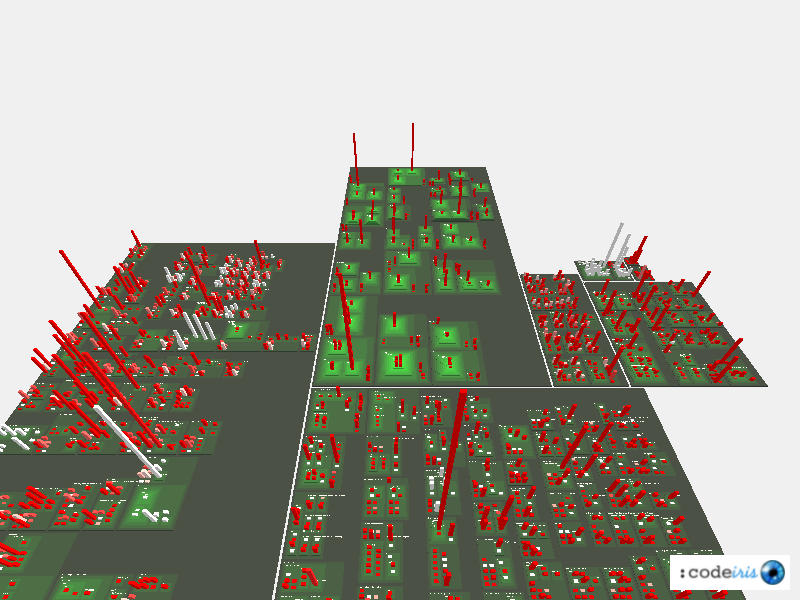
Knowledge loss
What it measures
Share of the lines of a file (by blame) written by authors without a commit in the last 180 days.
How to read it
Height is lines of code. White means the code comes from active authors, red means most of it comes from authors who are gone.
Why it matters
Tall red buildings are a lot of code that hardly anyone in the team still knows. Changes there are slow and risky, good candidates for pairing, documentation or a handover.
open interactive view more about this metric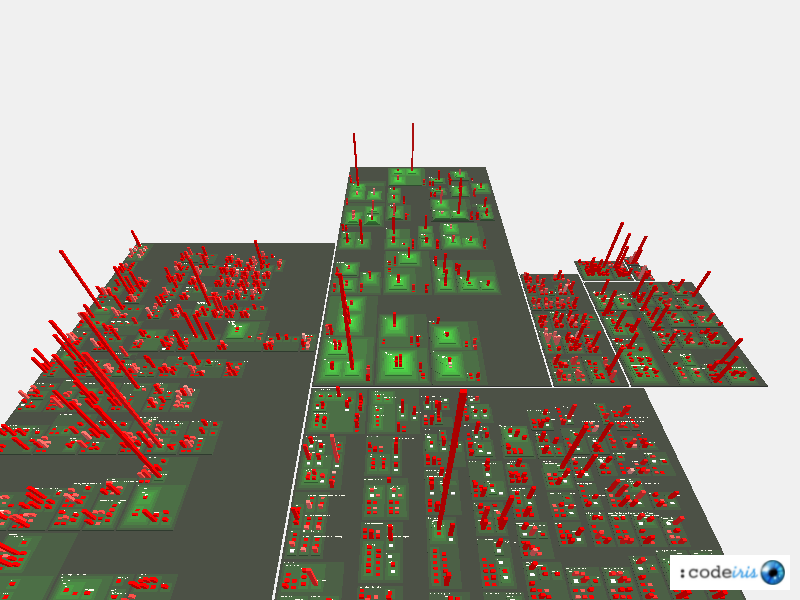
Contributor risk
What it measures
Share of the lines of a file written by its main author.
How to read it
Height is lines of code. Red means almost everything comes from one person, white means the knowledge is spread.
Why it matters
If that person leaves, the knowledge leaves with them (bus factor). Together with knowledge loss it shows where this is about to happen.
open interactive view more about this metric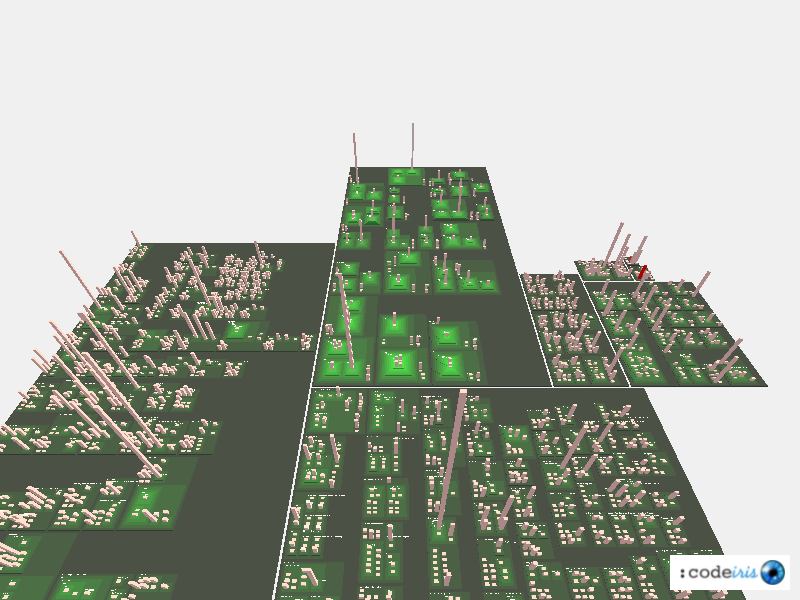
Change frequency
What it measures
Number of non-merge commits that changed a file.
How to read it
Height is lines of code, red means changed often. Tall red buildings are large files that change often, the hotspots.
Why it matters
Hotspots are where most bugs appear and where refactoring pays off most.
open interactive view more about this metric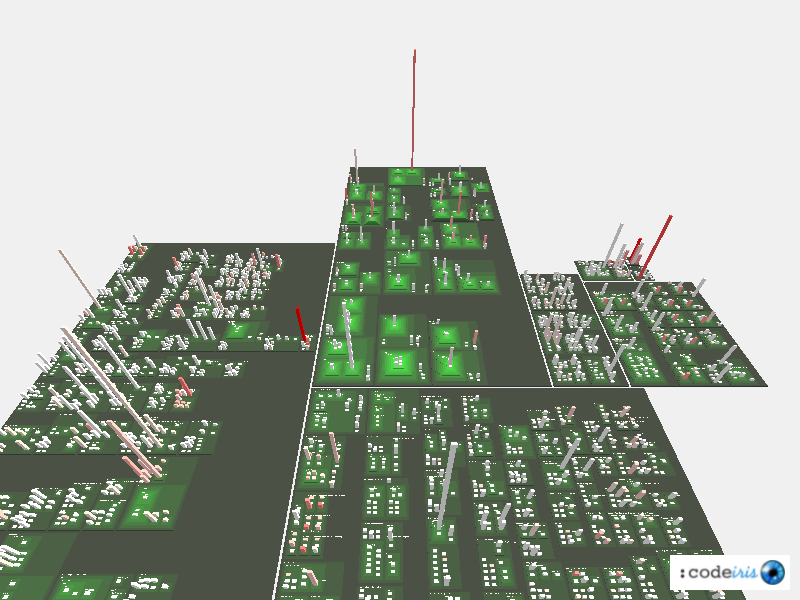
Churn and bug fixes
What it measures
Churn is the sum of lines added and removed over the history. Bug fix commits are commits whose message contains fix, bug, hotfix, defect or regression.
How to read it
Height is churn, red means many bug fix commits.
Why it matters
Code that is rewritten a lot and fixed often points to unclear requirements or a fragile design. Bug fixes are only detected by the commit message.
open interactive view more about this metric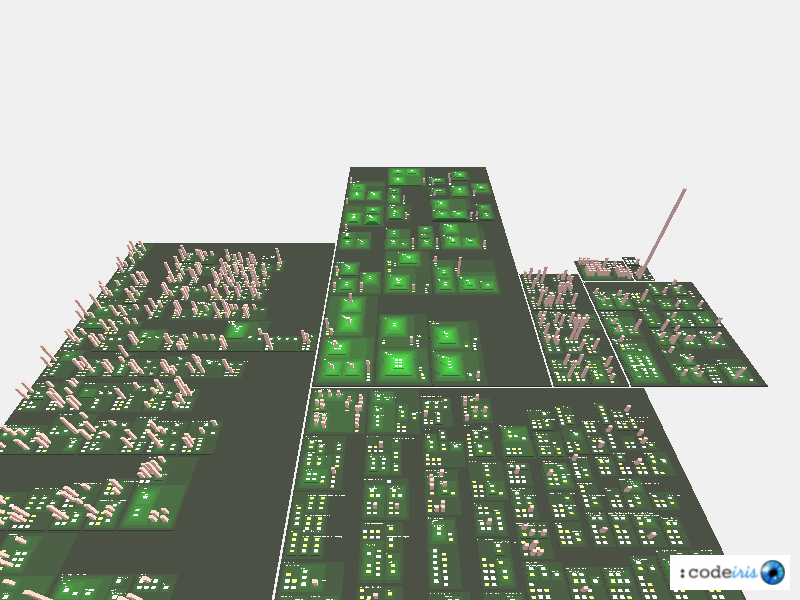
Changes within the last 360 days
What it measures
Number of commits that changed a file during the last 360 days.
How to read it
Height and color show the recent changes, red means changed often within the last year. Flat white buildings were not touched.
Why it matters
Separates the active parts of the project from stable or abandoned code.
open interactive view more about this metricMore metrics
These metrics have no screenshot on this page. Open them in the interactive 3D view.
Lines of code
Number of lines of a file.
Height is lines of code. Tall buildings are large files.
Large files are harder to understand and to change. Combined with other metrics it shows where problems weigh most.
File size
Size of a file in bytes as stored in git.
Height is the file size. Unlike lines of code it also covers binary files such as images.
Finds unexpectedly large files, for example generated code or binaries checked into the repository.
Number of commits
Number of non-merge commits that changed a file, renames are followed.
Height is the number of commits. Tall buildings were changed often.
Shows where development concentrates. Frequently changed files deserve good tests and clear structure.
Number of authors
Number of different authors who changed a file, unified by .mailmap.
Height is the number of authors. Flat buildings were changed by only one or a few people.
Many authors spread the knowledge but can mean unclear responsibility. A single author is a contributor risk.
Code age
Days between the last change of a file and the imported commit. For an older commit the age is measured at that commit, not today.
Height is lines of code. Red means not changed for a long time, white means changed recently.
Old, untouched code is either stable or forgotten. Together with knowledge loss it shows code nobody knows any more.
Hotspots
Number of commits multiplied by lines of code of a file.
Height is the hotspot value. The tallest buildings are large files that change often.
Hotspots are where most bugs appear and where refactoring pays off most.
Change coupling
Number of files that changed together with a file in at least 2 commits and in at least 30 % of its changes. Commits with more than 50 files are ignored.
Height is the number of coupled files. Tall buildings rarely change alone.
Shows hidden dependencies the code does not reveal. A change there usually needs changes elsewhere.
Cyclomatic complexity
Sum of the cyclomatic complexity (McCabe) of all functions of a file: the number of independent paths through the code, counted by Lizard for about 25 languages.
Height is the complexity. Tall buildings contain much branching logic.
Each path needs a test. Complex files are harder to test and to change safely. Combined with change frequency it shows the hotspots that matter most.
Cognitive complexity
Sum of the cognitive complexity of all functions of a file. Unlike cyclomatic complexity it weighs nesting, so deeply nested code counts more than flat code with the same number of branches.
Height is lines of code. Red means the code is hard to understand, white means it reads easily.
Code that is hard to read is where misunderstandings and bugs happen, for people and for AI assistants alike. Tall red buildings are good candidates for refactoring.
AI written code
Share of the lines of a file (by blame) whose last change came from a commit made with an AI coding assistant, detected by the assistant as author or co-author or by a generated footer. Inline completions leave no trace, so this is a lower bound.
Height is lines of code. Red means most lines come from an AI assistant and no person has changed them since, white means the code was written or last changed by people.
AI written code is not a problem in itself, but nobody has written it by hand. Together with complexity and knowledge loss it shows where the team may not know its own code.
Comprehension debt
Share of the lines of a file (by blame) that no active person wrote or changed last: lines from AI assisted commits and lines of authors without a commit in the last 180 days.
Height is lines of code. Red means hardly anyone in the team has written this code, white means active people know it first hand.
Like knowledge loss, but AI counts as an author nobody can ask. Tall red buildings are code to review, test and explain before the next larger change.
Complexity of AI written code
Cognitive complexity of a file combined with its share of AI written lines.
Height is cognitive complexity, red means mostly AI written. Tall red buildings are complex code that came from an AI assistant.
Complex code is hard to review. If it came from an AI assistant, it may have been accepted without being fully understood. These files deserve a careful review first.
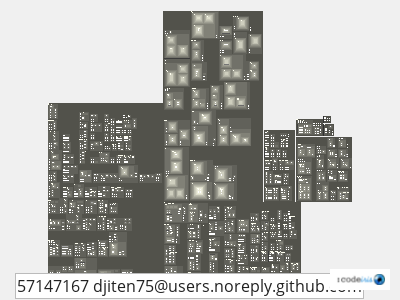
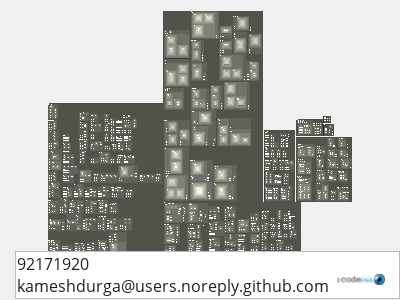
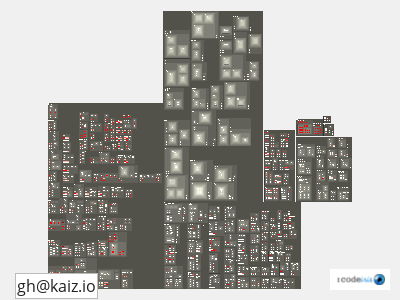
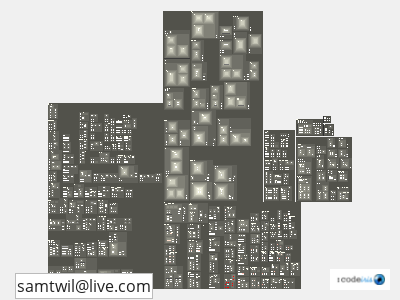
Top 9 contributors
Each city shows the impact of one contributor: the more of a file someone wrote, the more it is colored.